

Executive read
Gael Breton is best understood as an operator-educator who built Authority Hacker on the 2010s authority-site and affiliate SEO boom, then moved the brand aggressively toward AI automation as the classic niche-site model became more fragile.
Authority Hacker’s public story is coherent: founded in 2014 after Breton and Mark Webster sold a 30-person agency, 15,000+ paid customers, 80,000+ subscribers, and 3M+ podcast downloads. These are self-reported figures, but they fit a durable education/media business rather than a fly-by-night course brand.
The key strategic question is whether Authority Hacker can convert SEO-era trust into ownership of the next category: post-Google, AI-assisted growth systems for established small businesses and marketers.
Gael Breton profile
Public role: co-founder of Authority Hacker, currently described by the company as AI Strategist & Product Development. Authority Hacker says he runs 200+ experiments monthly and turns tested systems into training.
Positioning: Breton’s public profile leans “anti-hype AI operator.” His X bio says “Love: AI and automation. Hate: Hype,” matching the company’s current “No Hype AI & Automation” positioning.
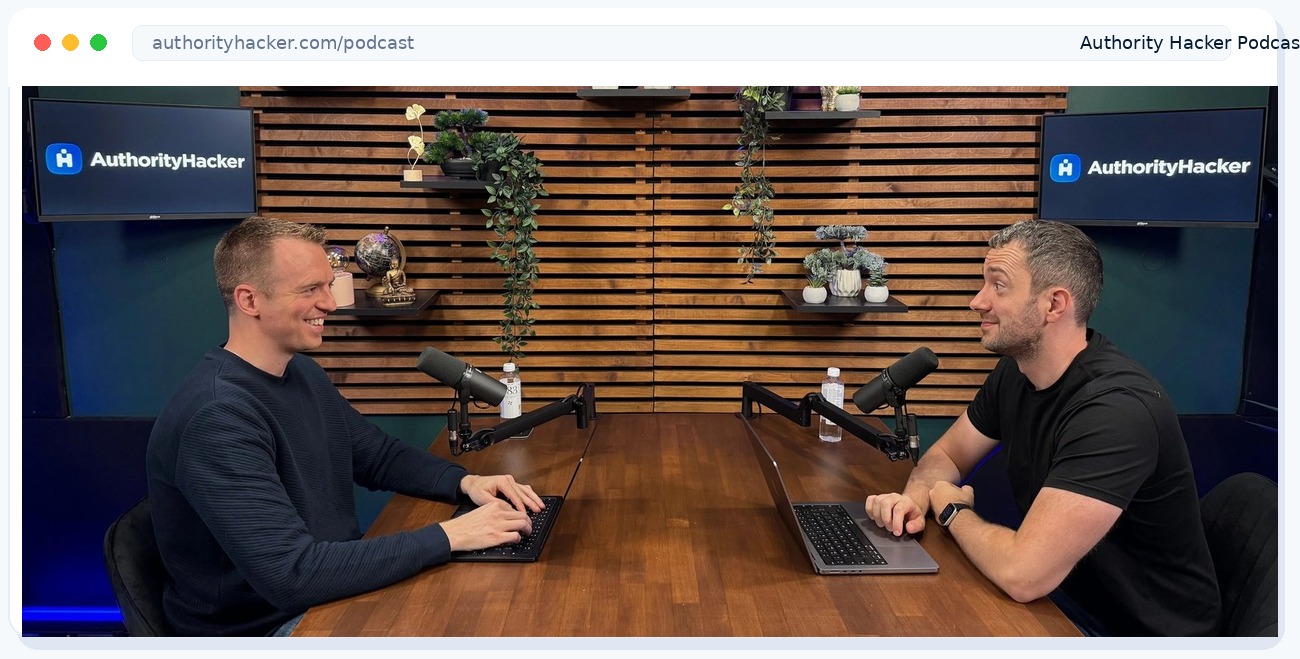
Public media: co-host of the Authority Hacker Podcast with Mark Webster. Third-party appearances include Niche Pursuits, where he discussed Google-update survival, first-hand expertise, mobile UX, parasite SEO, and AI as an editorial assistant rather than a replacement for substance.
Reputation: no substantiated personal controversy surfaced in accessible public sources. The main cautions are business-model related: self-reported metrics, paid-course incentives, strict refund windows, and historical reliance on volatile Google SEO.
Meeting intelligence for Carl
Likely conversation frame: he will respond better to practical operator-to-operator discussion than abstract AI hype. His public line is “test, then teach,” so lead with concrete workflows, shipped systems, and measured business impact.
Relevant credentials to know: public author archive copy says Gael has spoken at Harvard, Wharton, and Oxford and at industry events such as Chiang Mai SEO. It also says he specializes in funnels, email marketing, direct response, SEO, content, and affiliate marketing. Treat this as public bio copy, not independently verified biography.
Useful opener: ask what changed internally when they decided “the content site model is dead” while “SEO is not dead.” A LinkedIn search result preview from Gael says they were closing flagship SEO courses after 10 years because the content-site model changed. That is probably the emotional center of the current pivot.
Likely interests: Claude Code, AI agents for marketers, n8n/workflow automation, AI-assisted content operations, SEO recovery after HCU, newsletter/podcast funnels, high-ticket communities, affiliate/site operator pain, and practical no-code systems.
Avoid: pitching generic prompt libraries, “AI content at scale” without quality controls, get-rich-quick SEO claims, or anything that sounds like untested guru playbooks. Their brand currently defines itself against hype.
Good meeting questions: What AI workflows survive tool churn? Where are members getting measurable ROI? What do they believe Google still rewards? How are they thinking about GEO/AEO? How do they separate AI leverage from spam optics? What part of Authority Hacker’s SEO legacy still compounds versus what had to be abandoned?
Authority Hacker profile
Legal/operator footprint: Authority Hacker is operated by Judgement Media Ltd, using a UK contact address at 20-22 Wenlock Road, London. LinkedIn describes the company as a small advertising-services company founded in 2014.
Legacy business: education around authority sites, affiliate SEO, content production, link building, and monetization. Third-party reviews describe former high-ticket products such as The Authority Site System and Authority Hacker Pro, with reported prices from about $997 to several thousand dollars.
Current business: AI Accelerator, annual-billed membership tiers from $99/month, $199/month, and $1,000/month. The offer promises workflows, SOPs, templates, community, live calls, and implementation help for established businesses.
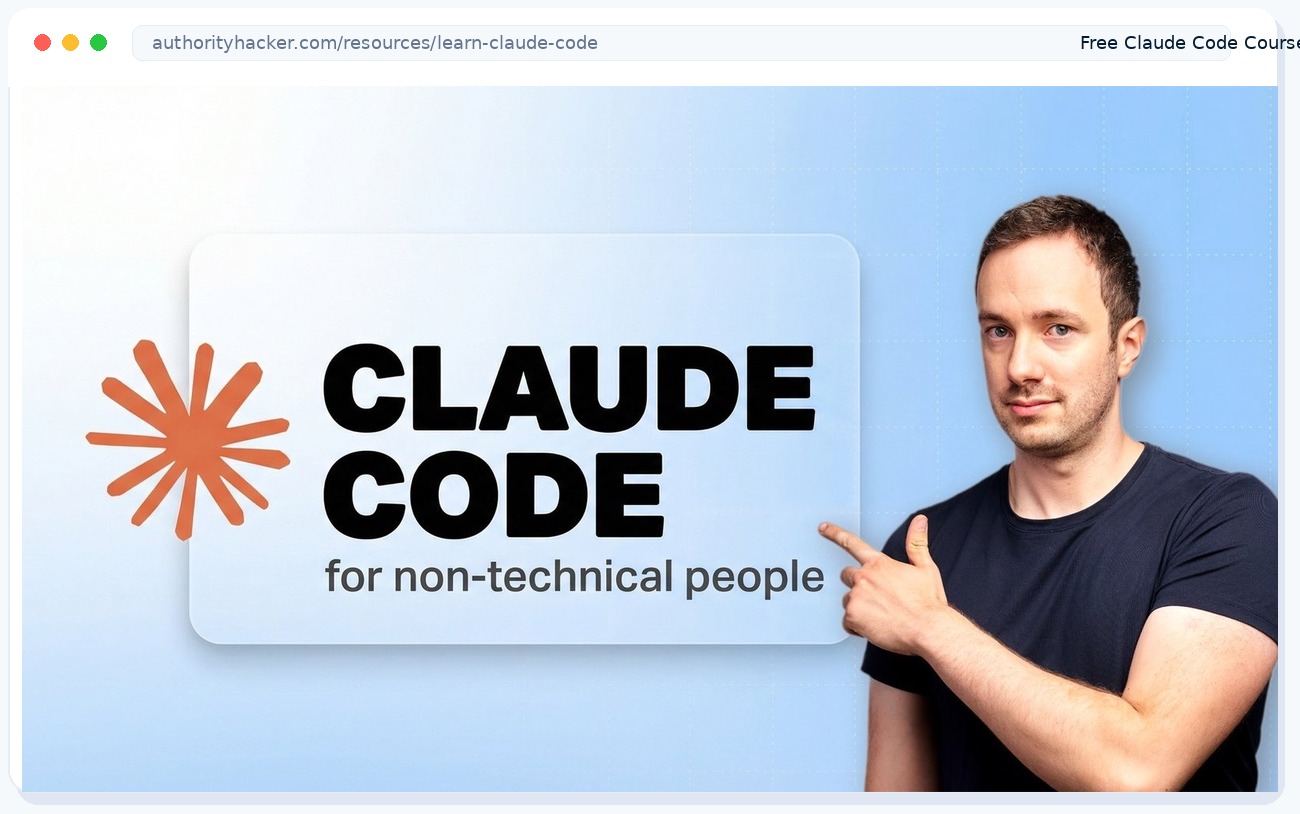
Funnel: free Claude Code course, podcast, newsletter, workflow library, and product-led public content. The current content engine is now more AI automation than classic SEO.
Market state
Affiliate marketing remains commercially meaningful. DemandSage estimates the market at roughly $15.7B in 2024, $17B in 2025, and trending toward $38B by 2030. SEO and blogging remain common affiliate channels.
But the independent niche-site formula is under severe pressure. Google’s helpful-content and March 2024 spam/core updates targeted scaled content abuse, expired domain abuse, and site reputation abuse. Independent publishers like HouseFresh reported catastrophic traffic losses.
AI Overviews further compress top-of-funnel informational traffic. Pew found users clicked traditional links 8% of the time when AI summaries appeared versus 15% without them, and clicked links inside summaries only 1% of the time.
Education demand has shifted from “how to rank affiliate posts” to “how to build defensible brands, original evidence, owned audiences, AI workflows, and revenue systems not wholly dependent on Google.”
Strategy diagnosis
Authority Hacker’s pivot is rational. Continuing to sell the old authority-site dream as the core promise would fight market reality. Reframing toward AI workflows for established operators lets the company keep its systems/SOP DNA while avoiding the most damaged claim: predictable Google-driven affiliate riches.
The risk is brand drag. “Authority Hacker” still evokes authority sites, affiliate SEO, and Google traffic. That history gives credibility with a specific tribe, but it may also narrow the market or trigger skepticism among operators harmed by Google updates.
The strongest strategic lane is “authority businesses,” not authority sites: owned audience, original data/testing, multi-channel distribution, automation, AI search visibility, and monetization diversity.
SWOT
Strengths: long-running brand since 2014; large claimed customer/audience base; strong operator-teacher identity; podcast trust; ability to package complex tactics into SOPs and templates; credible pivot into hands-on AI automation.
Weaknesses: heavy legacy association with SEO and affiliate sites; self-reported metrics are hard to independently verify; paid education competes with abundant free training; some legacy outcomes are less controllable in the post-HCU environment.
Opportunities: post-HCU recovery and diversification; AI workflow implementation for marketers; GEO/AEO/AI search visibility; first-hand review systems; automation templates; community and live implementation as differentiation from free courses.
Threats: Google volatility; AI Overviews reducing clicks; free education from Ahrefs, Semrush, HubSpot, Moz, YouTube, and Niche Pursuits; AI lowering content-production barriers; distrust toward guru/course businesses; platform risk if AI tools change rapidly.
Critique
Authority Hacker is not obviously scammy from the public record. It has longevity, public founders, a real media footprint, and external industry recognition. Scamadviser also classifies the domain as very likely safe, while noting WHOIS privacy.
The more serious critique is incentive alignment. Course businesses can overpackage uncertain channels as repeatable systems. Authority Hacker’s current copy partly addresses this by excluding beginners and emphasizing established businesses, but prospective buyers should still treat results as implementation-dependent.
The new AI Accelerator pricing creates a sharper promise problem. At $99 to $1,000/month billed annually, the buyer needs tangible ROI. “Interesting AI workflows” are not enough. The product must deliver implemented leverage, better output velocity, or revenue/cost impact.
Authority Hacker’s opportunity is to become the pragmatic antidote to AI hype. Its danger is becoming another fast-moving AI education brand whose workflows expire as tools change.
Recommendations
1. Reframe the category: from authority sites to authority businesses. Keep the name, but update the narrative.
2. Build a “Post-HCU Recovery & Diversification” product track for damaged publishers and affiliates.
3. Lead with implementation proof: before/after workflows, hours saved, revenue influenced, cost avoided.
4. Make GEO/AEO/LLM visibility a core pillar, not a side topic.
5. Avoid AI content-farm optics. Emphasize AI for research, operations, repurposing, QA, internal tooling, outreach, and analysis.
6. Differentiate from free courses with templates, audits, live calls, peer group, and current experiments.
Bottom line
Gael Breton and Authority Hacker look like a serious, adaptive operator-led education business at a pivotal moment. The old market was “teach people to build affiliate authority sites.” The new market is “help operators survive the collapse of easy SEO arbitrage and exploit AI without becoming spam.” If Authority Hacker keeps proving real workflows and avoids nostalgia for the old niche-site model, the pivot makes strategic sense.
Public sources reviewed
- [1] Authority Hacker homepage
- [2] Authority Hacker About
- [3] Authority Hacker Contact
- [4] Authority Hacker Privacy Policy
- [5] Authority Hacker Refund Policy
- [6] AI Accelerator
- [7] Workflows
- [8] Free Claude Code course
- [9] Podcast
- [10] Claude Code announcement
- [11] Gael Breton X
- [12] Niche Pursuits interview
- [13] Apple Podcasts
- [14] LinkedIn company page
- [15] Semrush traffic overview
- [16] Scamadviser
- [17] NorthiScale review
- [18] The Affiliate Marketing Lifestyle review
- [19] Marks Insights review
- [20] Gael Breton author archive
- [21] CourseMethod interview
- [22] Google Helpful Content update
- [23] Google March 2024 core update
- [24] Google helpful content guidance
- [25] Google AI content guidance
- [26] Amsive HCU analysis
- [27] HouseFresh Google traffic story
- [28] The Verge on independent sites
- [29] Pew AI summaries click study
- [30] Semrush AI Overviews study
- [31] DemandSage affiliate statistics
- [32] Income School Project 24
- [33] Niche Pursuits
- [34] Ahrefs Academy
- [35] Semrush Academy SEO
- [36] Moz Academy
- [37] HubSpot SEO Academy
- [38] Coursera SEO specialization
- [39] Udemy SEO courses